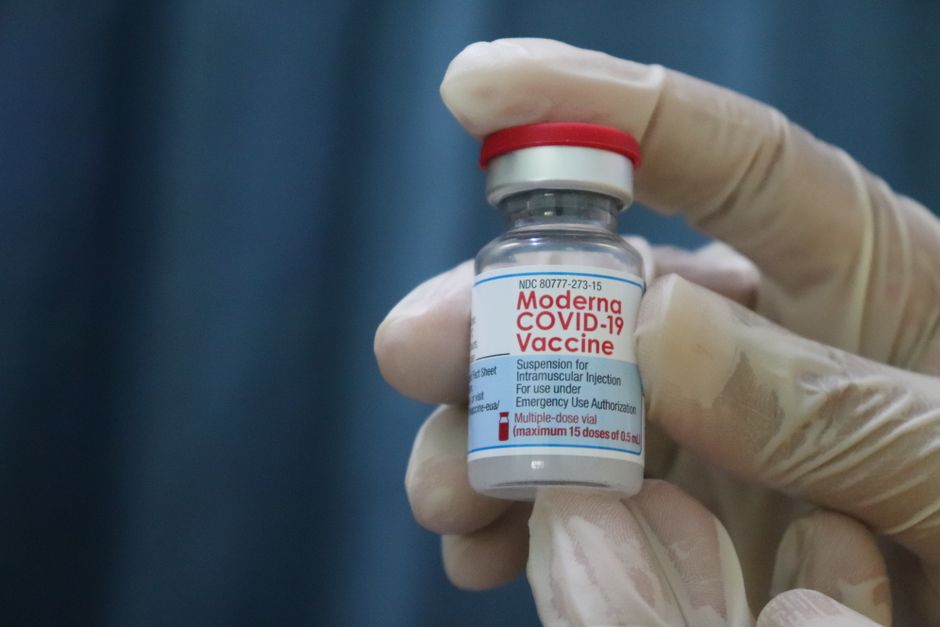
In the INTerpath-001 Phase 3 trial, adding intismeran autogene, an individualised mRNA therapy, to Keytruda (pembrolizumab) reduced recurrence or death in resected melanoma. The companies' figures put the effect at a 42% relative reduction in hazard, or a hazard ratio of 0.58. That is the headline, and it is easy to misread. It is not the share of patients who avoided recurrence. The absolute difference is about 12 percentage points at two years, and the trial has not shown that people live longer.
The Moderna Merck melanoma vaccine trial is the first large randomised test of this approach in a setting where the comparator is already an active drug. Pembrolizumab is an established immunotherapy, and the trial asked whether adding the individualised product improves on it after surgery. This article sets out what the companies' data and the coverage built on them actually establish, and where the evidence stops.
Background: the product and the trial design
Intismeran autogene is made for each patient from targets found in that patient's tumour. The companies describe it as an individualised neoantigen therapy, a term that refers to the tumour-specific mutant proteins a personalised immune response can target. Media coverage often calls it a vaccine, but it is given after surgery to patients with cancer, not to healthy people to prevent it. Each product is manufactured for one patient, so a tumour sample and sequencing come before treatment begins.
According to Dermatology Times, INTerpath-001 randomised 1,137 patients with resected stage IIB to IV melanoma in a 2:1 ratio. The combination arm received intismeran at 1 mg every three weeks for up to nine doses, plus pembrolizumab at 400 mg every six weeks for up to nine cycles. The companies' topline material describes the control arm as pembrolizumab alone; several secondary sources describe it as placebo plus pembrolizumab. The sources reviewed do not settle which wording is right.
What the trial reported
The companies report a hazard ratio of 0.58 (95% confidence interval 0.45 to 0.75; p below 0.001) for recurrence or death in the intention-to-treat population, at a median follow-up of 24.6 months. Merck and Moderna presented the data at ESMO Congress 2026 as a Presidential Symposium late-breaking abstract and say the paper has been accepted by the New England Journal of Medicine. The sources reviewed do not include the full paper, so the subgroup results, the tolerability tables and the exact method behind the hazard ratio remain unchecked.
A hazard ratio is a model-based summary, not a count of patients. It assumes that the two arms' hazards stay in a fixed proportion over follow-up, which is the proportional-hazards assumption. Under that assumption, a ratio of 0.58 means the combination arm's instantaneous rate of recurrence or death was about 58% of the control arm's rate. The 42% is 100 minus 58. If the curves cross or the gap changes over time, the single number hides that, and the paper is where a reader would check it.
What 42% means in plain numbers
The 42% and the absolute gap describe the same result on different scales. The hazard reduction says how fast events happen in one arm relative to the other. The percentage-point gap says how many more patients are still free of recurrence at a fixed time. The companies report two-year recurrence-free survival of 82.2% on the combination and 70.0% on pembrolizumab alone, a gap of about 12 percentage points. An outside UK expert quoted by the Science Media Centre put it as roughly 12 more people per 100 free of recurrence.
Relative figures look larger because they are measured against a small baseline of relapses. OncoDaily's summary of the abstract gives crude event counts of recurrence or death in 136 of 757 patients on the combination (18.0%) versus 111 of 380 on pembrolizumab alone (29.2%). These are untimed proportions from a secondary summary, and they do not reproduce the 12-point Kaplan-Meier gap exactly; the crude difference is about 11.2 points. They point the same way, but they are not a substitute for the trial's time-to-event analysis.
Where this sits against earlier evidence
The Phase 2b KEYNOTE-942 trial came first. According to Biopharm International, it reported a hazard ratio of 0.51 at five years, a 49% reduction in recurrence or death. That study was small, and coverage reviewed here gives different timepoints for related figures, so the number should be treated as a preliminary signal. It makes the Phase 3 result more plausible without proving it.
The companies also say this is the first positive Phase 3 readout for an individualised neoantigen therapy and for an mRNA-based cancer therapy. These are company self-descriptions and have not been independently checked.
Recurrence-free survival and distant metastasis
Two endpoints were met: recurrence-free survival (RFS) and distant metastasis-free survival (DMFS). The companies report two-year DMFS of 88.5% on the combination versus 80.2% on pembrolizumab alone. MedicalXpress describes a 38% reduction in distant metastasis or death, and OncoDaily's abstract summary gives a DMFS hazard ratio of 0.62. A hazard ratio of 0.62 is arithmetically a 38% reduction, so the two figures are consistent with each other. What the sources do not establish is whether MedicalXpress's 38% is the same hazard-based measure for the same endpoint, or a different calculation. The primary paper or ESMO slides would settle that. The two-year proportions are a separate kind of number and should be read as such.
What the trial does not show
Overall survival has not been shown to improve. It was a key secondary endpoint, and OncoDaily's overview says overall survival is still under evaluation with follow-up ongoing. The endpoints met were RFS and DMFS. Neither measures deaths averted, so the result should not be described as reduced mortality. Some secondary material uses "recurrence and mortality" wording; the sources reviewed do not support it.
Side effects and treatment burden
The companies report no new safety signals. Medscape reports no substantial increase in severe treatment-related adverse events. The non-severe differences are large. According to the OncoDaily abstract summary, injection-site pain occurred in 51.0% of combination patients versus 9.5% on pembrolizumab alone, and pyrexia (fever) in 52.2% versus 8.2%. Independent experts quoted by the Science Media Centre flagged more fever and tiredness. These figures come from an abstract summary and have not been checked against the paper.
The event types suggest reactogenicity, meaning transient reactions to an injected immune stimulus, rather than organ toxicity. That is an interpretation of the reported event types, not a finding any source states.
Access, manufacturing and cost
The sources reviewed contain no regulatory filing or decision, although the companies say regulatory interactions are planned. A UK expert told the Science Media Centre that the product remains experimental, is not currently available on the NHS, and has no confirmed timeline.
Manufacturing is the practical constraint. Medscape reports that personalised production is complex and time-consuming. The article reviewed gives a figure of roughly 17% of screened patients with inadequate tissue for production; this figure has not been confirmed against the Medscape wording and is flagged for the editor. Cost, reimbursement and turnaround times are not addressed in the sources reviewed.
Evidence assessment
Strong: Recurrence-free survival was better with the combination than with the control arm in INTerpath-001, as reported in the companies' topline and ESMO material and repeated by trade outlets that draw on those releases. This rests on company data, not on the full paper.
Moderate: The hazard ratio of 0.58 (95% CI 0.45 to 0.75) and the two-year RFS gap of about 12 points (82.2% vs 70.0%). Both come from company material and abstract coverage, and the full paper has not been reviewed. The DMFS improvement (88.5% vs 80.2% at two years) rests on the same kind of source, and its hazard framing is inconsistent across coverage. Event counts and adverse-event percentages come from an abstract summary. The "no new safety signals" and "no substantial rise in severe adverse events" statements rest on company statements and secondary coverage.
Weak or preliminary: The KEYNOTE-942 Phase 2b results, which were small and reported at differing timepoints. The companies' "first" claims, which are self-descriptions. The views of individual independent experts, each a single voice.
Unknown: Overall survival. The full NEJM paper, including subgroups, tolerability detail and the method behind the hazard ratio. Whether the control arm was placebo plus pembrolizumab or pembrolizumab alone. Regulatory status, timing, price and reimbursement. How the combination fits alongside other adjuvant options, and whether the benefit holds across stage IIB, III and IV disease in patients outside the trial's eligibility.
Practical implications
Anyone quoting this result should give the absolute figure, about 12 percentage points at two years, next to the 42% relative figure, and say that 42% is a hazard reduction. Coverage should avoid "mortality" and "survival benefit" language until overall survival is reported.
Patients with resected melanoma who want trial access should ask their oncology team which studies are open and whether tumour tissue can be used for manufacturing. Outside a trial, the sources reviewed do not suggest the product will reach routine care soon.
For developers of personalised cancer therapies, the sources point to logistics as well as efficacy. Tissue adequacy, manufacturing turnaround and per-patient cost will shape whether a trial benefit becomes routine treatment.
Limitations and open questions
The central results come from topline and abstract material, and the sources reviewed carry company framing. The full NEJM paper will settle the comparator wording, the DMFS expression, the adverse-event rates and the subgroup picture. Overall survival matters most to patients and needs longer follow-up; the sources give no timeline for mature data. Benefit outside the trial population is untested.
Editor's take
The evidence supports a firm conclusion on recurrence. In this trial, adding the individualised therapy to pembrolizumab delayed recurrence or death. The 42% is an accurate relative hazard reduction, and it is the companies' headline. On its own, though, it overstates what a typical patient should expect. The roughly 12-point gap at two years is the better guide, and it is still a company-sourced figure until the paper is read.
In my assessment as editor, a 12-point gap in two-year recurrence-free survival is large enough to warrant close follow-up, though that judgement rests on the editorial reading, not on a clinical threshold cited in the sources. What the evidence does not support is any claim about survival. Recurrence-free survival is the endpoint that moved, and whether it translates into longer life is unknown. The treatment burden and manufacturing constraints are real, and they belong in any decision about this product alongside the efficacy numbers.
Topic note for readers: this is a biomedical story. Its link to the site's focus is the individualised mRNA platform, which is applied biotechnology, not machine learning or software.