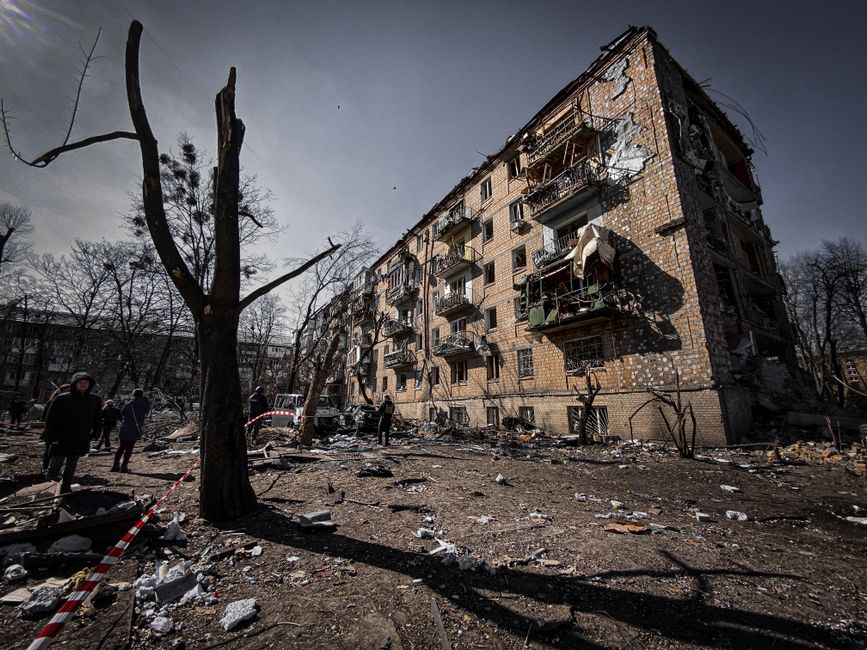
Russian attacks killed at least nine people across Ukraine over the day to 21 October, according to Ukrainian local authorities as reported by the Kyiv Independent and Africanews. That minimum is the best-supported number in the coverage. The other figures, for injuries, Kyiv deaths and drones, come from different scopes and different governments, and they do not reconcile into one account.
The strikes came as US envoy Steve Witkoff met Vladimir Putin, and both sides were reported to have agreed in principle to resume US-brokered talks. No date, venue or delegation has been announced for those talks, so the diplomacy and the strikes should be treated as separate tracks.
What the nationwide toll measures
The Kyiv Independent reported at least nine killed and 45 injured across Ukraine, citing local authorities. Africanews gave the same nationwide minimum of nine, with one death each in Kyiv and Kharkiv and others in Sumy, Zaporizhzhia and Donetsk, and described its count as covering the "past 24 hours", a window that is not identical to the Kyiv Independent's day to 21 October. Africanews also reports that people may be trapped under rubble in Kyiv, which means the count could rise. The Kyiv Independent carries a later headline giving nine killed and 57 injured, but that figure appears on a page about a Trump remark rather than a dedicated casualty report, and I could not confirm it on a dedicated report, so it is shown here only as an unverified headline figure. An aggregator, Archyde, gives 56 injured; it is a low-quality source and is excluded from this account. Injury counts differ by outlet, and each should be read with its attribution attached.
Kyiv: figures that cover different areas
Kyiv-only numbers conflict because the outlets counted different areas. Al Jazeera, citing AFP, reported one person killed and 22 injured in the capital. The Kyiv Post reported one dead and 24 injured in Kyiv, and damage to metro infrastructure at the South Bridge. Euronews, citing Zelenskyy, reported at least two killed and 34 injured across affected areas, which is a wider scope than the capital alone. Those are not like-for-like figures, and no single Kyiv number can be drawn from them. Casualty counts at strike sites are often revised as rescue work continues and records are reconciled, so the sensible reading is a range with attribution, not an average.
Missiles, drones and the cluster-warhead claim
Euronews, relaying Ukrainian Air Force figures, reported that Russia used 210 drones, 110 of them jet-powered, along with Iskander-M, S-400, Zircon and Onyx missiles. According to the same report, 181 drones were intercepted or suppressed and strikes hit 32 locations. Zelenskyy said Russia fired 21 missiles in three ballistic waves at Kyiv. Euronews's headline says Russia "reportedly" struck central Kyiv with a cluster-warhead ballistic missile. The claim is attributed to Zelenskyy, and the reporting does not confirm it. Cluster warheads scatter submunitions over a wide area, which is why the claim would matter if true, and it is also why a claim of this kind needs the munition identified by someone outside the government making it.
Ukraine's drone attack on Moscow
Reuters, via Cyprus Mail, reported that Moscow Mayor Sergei Sobyanin put the number of drones sent toward the Moscow region overnight at 630, most downed at long range, with two people wounded. The Russian Defense Ministry, as reported by TASS, said 808 Ukrainian drones were intercepted overnight across several regions, including Moscow, Leningrad, Kursk and Crimea, with two injured in Moscow and one in Lipetsk. The two figures measure different things. Sobyanin's count covers drones sent toward one region; the ministry's covers interceptions across the country over a night. Both could be accurate. Neither has been independently verified, and none of the reporting checked confirms damage to the Moscow refinery or any other target. The Moscow-side damage picture comes largely from Russian officials, which is a reason to hold damage claims loosely.
Repeat attacks and earlier counts
Newsweek reported that an October 6 Ukrainian attack involved nearly 700 drones toward Moscow and killed two people. Al Jazeera put the same attack at 650 drones, citing Sobyanin. The gap between those two counts for one event shows how loosely drone numbers travel between outlets. Newsweek also mentions a September 20 attack of roughly 450 drones; that appears only as a retrospective mention in a single outlet and has not been checked against other reporting. On the Russian side of the ledger, the Washington Post reported that Russian strikes on Kyiv and a dozen other regions killed at least 25 civilians on 7 October. Kyiv Independent reported that a 13-14 October strike on a Kyiv residential building also hit power plants, killing five and injuring 25, and that Zelenskyy said 600,000 people were without power at the time of reporting. Strikes on Kyiv were therefore already repeating before this week's attacks. Separately, an AP report carried by Netscape on 20 October said Zelenskyy claimed Ukraine had nearly run out of American Patriot interceptors for ballistic missiles. That is Zelenskyy's claim; the Pentagon's position on the matter is not reported in the material checked.
Do the strikes affect peace talks
According to Al Jazeera and The Globe and Mail, Witkoff met Putin to push for renewed talks, and Putin reportedly agreed in principle to resume three-way talks, with no date set. Africanews reports that Moscow and Kyiv reportedly agreed in principle to resume US-brokered talks. "Agreed in principle" is a signal from diplomats, and it does not establish when or whether a meeting will happen. The strikes do not show whether that signal will hold. A named date, venue or delegation would be the first real evidence that talks are moving.
Evidence assessment
Strongly supported: Russian attacks killed at least nine people across Ukraine over the day to 21 October, per Ukrainian local authorities, as reported by two outlets, the Kyiv Independent and Africanews. Ukraine and Russia both reported large drone operations toward Moscow in the same period.
Moderately supported: The October 7 strikes that the Washington Post reported killed at least 25 civilians, and the 13-14 October Kyiv strike reported by the Kyiv Independent (five killed, 25 injured), each rest on a single outlet in the material checked. The Ukrainian Air Force missile and drone breakdown, as relayed by Euronews, is also single-outlet. Witkoff's meeting with Putin and the "agreed in principle" language rest on reporting of diplomatic statements.
Weak or preliminary: The cluster-warhead claim, which is Zelenskyy's and is reported as "reportedly." The Patriot shortage claim, which rests on Zelenskyy's statements. Damage claims for the Moscow attack, which come mainly from Russian officials. The 57-injured headline figure, which sits on an unusual page. The September 20 attack count, which appears in one retrospective mention.
Unknown: The final nationwide toll and its exact time window. Independent verification of either side's drone numbers. Whether any Moscow refinery or other target was damaged. The Pentagon's position on Patriot supply. Whether talks have a date, venue or delegation.
Practical implications
If you quote the nine-death figure, attribute it to Ukrainian local authorities, state the window the outlet used, and say it is a minimum. For Kyiv, cite individual outlets rather than an average, because the scopes differ. For drone counts, name the body that issued the figure and what it counted: a region, a night, or a set of interceptions. If you build news monitoring or summarisation tools, this case is a useful test. The sources here disagree on scope and timing, not on basic facts. A summariser that merges the Sobyanin and Defense Ministry numbers into a single "drones on Moscow" figure would produce a tidy line that misstates both. Checking whether a system keeps the attribution and the counted scope is a cheap way to find that failure.
Limitations and open questions
An official Ukrainian update giving the final toll and its window would settle most of the nationwide discrepancy. Reconciling the Kyiv figures would need a breakdown by district and time, which the reporting does not provide. Independent verification of drone counts would need sources outside both governments. The cluster-warhead claim would need the munition identified by a party outside the Ukrainian government. The talks question would be answered by a named date, venue and delegation.
Editor's take
The nine-death figure is the best-supported number in this coverage. It is attributed to Ukrainian local authorities, it appears in two outlets, and it is a minimum. The figures most likely to mislead a reader are the drone totals. Sobyanin's 630 and the Defense Ministry's 808 describe different things, and each government has its own reasons for the framing it chooses. They are official claims about scale, and they should be reported as such. On talks, the reporting supports caution. "Agreed in principle" after an envoy meeting is more than nothing, but it has no date, venue or delegation attached yet. Until one appears, the strikes and the diplomacy are best read as two separate tracks.
This article is AI-assisted and reviewed by the responsible editor, Abhay Patel, before publication.